School Culture
Transformation
Transforming the everyday moments of school life to create environments where every child feels safe, respected, included, and able to thrive.
Creating schools where every child can thrive.
India’s education system is evolving rapidly. The National Education Policy (NEP 2020) emphasizes holistic development, experiential learning, and the nurturing of critical thinking, collaboration, and socio-emotional competencies. Policy alone cannot transform what happens inside a classroom. The real shift happens in the everyday, often invisible moments of school life: how teachers engage with students, how students treat one another, how discipline is approached, and how a student's voice is encouraged. These moments, repeated daily across thousands of interactions, become central to a child's ability to learn, feel safe, and thrive.
A safe and inclusive school is not simply one free of physical harm; it is one where every child—regardless of background, caste, ability, or gender—feels seen, respected, and able to participate fully. When students feel psychologically safe, they take the risks that real learning demands: asking questions, admitting confusion, trying and failing, and trying again. When they don't, learning narrows to compliance, and a child's potential goes untapped. Research consistently shows that school climate—the tone set by adult behavior and institutional practice—is one of the strongest predictors of student engagement, wellbeing, and academic outcomes, often mattering as much as the curriculum itself.
Because every school environment is unique, our approach to culture transformation is intentionally tailored to each school context. This starts with deep listening to teachers, principals, and administrators to understand their specific needs and co-design a plan. Since 2021, we have worked to translate this principle into practice, transforming school culture across two very different settings: a government residential school model spanning 257 schools, and Campion International School. Together, these engagements have allowed us to test, refine, and ground our approach in both large-scale public systems and independent school settings—with the intention of scaling this model across the country, and offering lessons that may resonate well beyond it.
Project Sampoorna:
Nurturing the Whole Child
India has the world’s fastest growing economy—as it grows, however, there are groups that are being left behind. Children from underprivileged communities are not equipped to take advantage of the country’s educational and economic progress, and are in danger of being left behind.
In Telangana, India’s fourth-largest state with the 7th-strongest ranked state economy, the literacy rate among Grade 3 students is 67% and numeracy is 70%—well above the national average—but these averages mask historic inequities for marginalised learners from Scheduled Castes (SC), Backward Castes (BC), and Scheduled Tribal communities (ST). The Telangana Social / Tribal Welfare Residential Education Institution Societies (TSWREIS/ TTWREIS or the “Society”) has emerged as a progressive government response to providing equitable education opportunities for members of the SC, ST, BC, and other minority communities. In Telangana, the Society envisions creating outstanding residential schools that provide high-quality, holistic, and value-based education to marginalised children that will enable social mobility and empowerment.
While progress towards this goal is clearly evident, systems strengthening and innovation are required to fully achieve them.
What would it take for schools to truly support the development of the whole child, beyond academics?
Since December 2020, the University of Notre Dame’s Global Center for the Development of the Whole Child (GC-DWC) has partnered with the Society as the anchor organisation of Porticus’s Project Sampoorna. The goal: to build, operate, and replicate a Whole Child Development (WCD) model of education in India, ensuring disadvantaged children develop academically, emotionally, socially, and are prepared to thrive in the formal economy.
Project Sampoorna supports the Society’s vision by:
- Strengthening school culture to foster transformational potential in every child
- Aligning systems-level leadership, school directors, teachers, and students around holistic practices
- Providing tools, training, and ongoing support to sustain impact over time
Five interconnected areas for holistic growth
From 2021 to 2022, the GC-DWC engaged deeply with school leaders, teachers, students, and parents. A comprehensive systems-mapping process revealed five interconnected areas for holistic growth:
Academic Skills
Health & Nutrition
Work Readiness
Safety & Protection
Social & Emotional Learning (SEL)
Creating safe, emotionally responsive environments
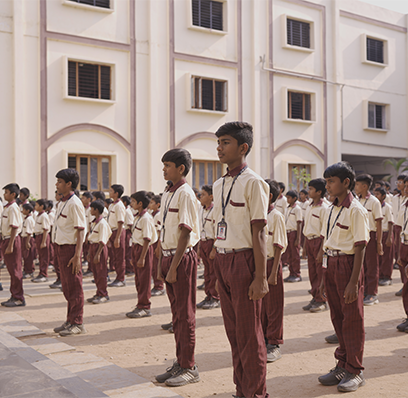
To address the gap, the GC-DWC operationalised SEL (Social and Emotional Learning) at the whole-school level, ensuring that every adult in the school ecosystem contributed to creating safe, emotionally responsive environments.
From experimentation to expansion.
- Developed school-wide and classroom-level SEL practices
- Introduced an adaptive learning system for feedback and course correction
- Ran intensive training, bite-sized actionable content, and ongoing support
- Early signs of success led to expansion to 61 schools via a Training of Trainers (ToT) model
Building Strong Foundations for the Future
Key Insight: In-service training matters but true systemic change requires pre-service teacher education.
- 2023: Partnered with Osmania University to pilot a two-credit Whole Child Development course for B.Ed students
- Strong reception → Expanded to all 70 affiliated B.Ed colleges in 2024
- Launched faculty development programs and provided ongoing handholding support
- Extended this model to 29 affiliated B.Ed Colleges under Palamuru University
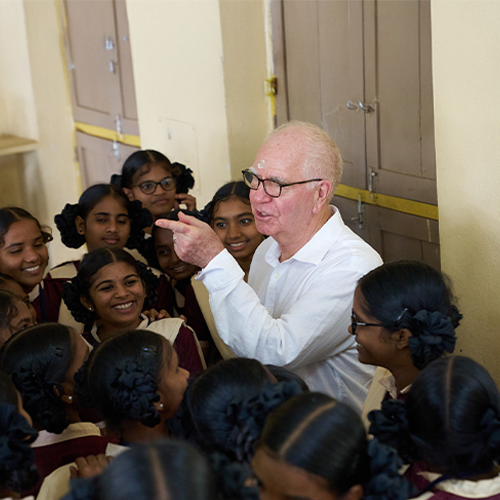
Scaling In-Service Support
2024–25:
- Trained 237 teachers, one per Telangana Social Welfare Residential School, to lead SEL implementation
- Used a hybrid learning model: online modules + in-person workshops
- Provided experiential training, practical assignments, and post-training assessments
- Ensured SEL became part of the everyday classroom and school culture
Project Sampoorna is now a growing ecosystem:
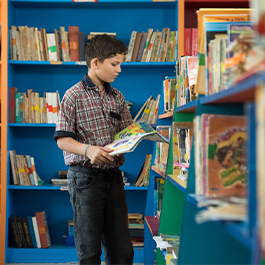
Engaging pre-service and in-service teachers
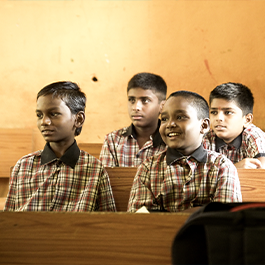
Co-creating with government leadership
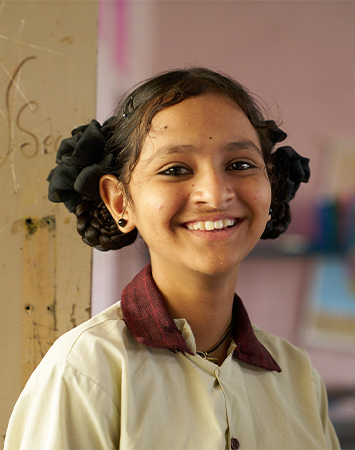
Staying rooted in the lived realities of school communities
Campion School Transformation
Campion is a Mumbai-based private school with around 800 students from pre-k through secondary school. The GC-DWC and its in-country partner, Whole Child India, have initiated a school culture program in the academic year 2026/2027 to strengthen teaching practice, reflective pedagogy, and student empowerment.
Utilizing a combination of focus group discussions, surveys, and interviews, WCI worked to understand the baseline of the institutional systems and lived classroom experiences across the school ecosystem. Included stakeholders were school students, staff, school administrators, and teachers.
The insights generated through this phase have informed the development of a 10 month program inclusive of reflexive teacher training, school thematic assemblies, and activities such as cooperative games to facilitate open conversation between peers and faculty.
Reflexive Teacher Training
Strengthening teaching practice and reflective pedagogy across the school ecosystem.
School Thematic Assemblies
Creating shared spaces for dialogue, reflection, and whole-school participation.
Cooperative Games
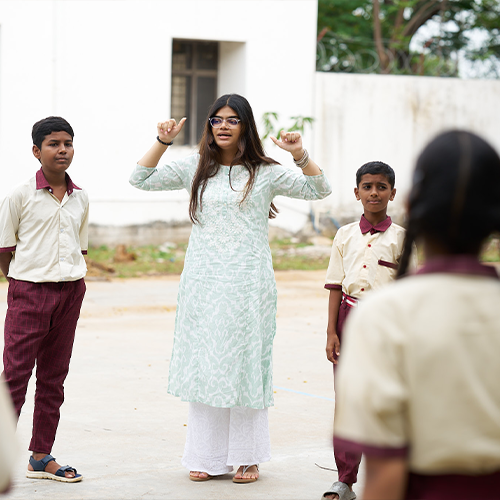
Facilitating open conversation between peers and faculty through activities designed to encourage connection.
Equip children to be academically prepared, emotionally safe, socially aware, and confidently ready for life.
Building school cultures where everyday interactions become part of every child's ability to learn, feel safe, participate fully, and thrive.